Welcome!
By registering with us, you'll be able to discuss, share and private message with other members of CityRP.
SignUp Now!You are using an out of date browser. It may not display this or other websites correctly.
You should upgrade or use an alternative browser.
You should upgrade or use an alternative browser.


Case: Adjourned Death Thegreatfired v. Azalea Isles (2026) CV 24
- Thread starter Aero
- Start date

- Joined
- Dec 24, 2025
- Messages
- 65
Your honor,
The plaintiff was in direct violation of the law by not having the required machinery on site and accessible to inspectors. This is not a case of the ministry picking on one person. They didn’t have the items required by law,and refused to allow the inspectors to verify if their claim of no industrial equipment was correct.
The plaintiff just ignored the procedure of inspections, while also not having the required machinery that could be used to keep the inspection solely on public ground. This was willful violation of the law. The law gave a way for inspections to be done without entering the property. All they had to do was have a production monitor on the outside. Without this, it was impossible for the ministry to determine that the plaintiff didn’t have any industrial equipment without a full inspection of the property which the plaintiff also denied.
The ministry fairly applied the law as written. The plaintiff decided the law didn’t apply to them. Therefore they faced the charges as written.
although parts of the initial law were a little rough, amendments were made to allow for better application. However, disagreeing with a law does not mean you can’t not follow it.
The defense asks the court to uphold the fines, as the plaintiff was in violation of the law.
The plaintiff was in direct violation of the law by not having the required machinery on site and accessible to inspectors. This is not a case of the ministry picking on one person. They didn’t have the items required by law,
The plaintiff just ignored the procedure of inspections, while also not having the required machinery that could be used to keep the inspection solely on public ground. This was willful violation of the law. The law gave a way for inspections to be done without entering the property. All they had to do was have a production monitor on the outside. Without this, it was impossible for the ministry to determine that the plaintiff didn’t have any industrial equipment without a full inspection of the property which the plaintiff also denied.
The ministry fairly applied the law as written. The plaintiff decided the law didn’t apply to them. Therefore they faced the charges as written.
although parts of the initial law were a little rough, amendments were made to allow for better application. However, disagreeing with a law does not mean you can’t not follow it.
The defense asks the court to uphold the fines, as the plaintiff was in violation of the law.

- Joined
- Nov 13, 2025
- Messages
- 493
- Thread Author
- #63
MOTION TO STRIKEand refused to allow the inspectors to verify if their claim of no industrial equipment was correct.
Your Honour, the Defense is asserting facts not in evidence. They have provided no evidence, and secured no testimony that would back this claim. We move the Court to strike this statement from the record.
- Joined
- Dec 24, 2025
- Messages
- 65
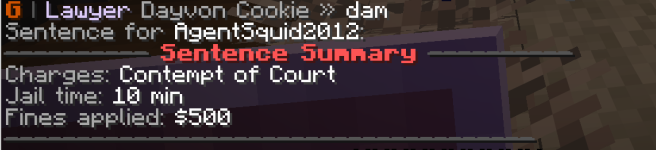
Your honor,The witness, Mr. Cookie (@Agentsquid2012), is hereby held in contempt of court. The Ministry of Justice is hereby instructed to impose a sentence of 10 minutes of jail time and a $500 fine.
The Plaintiff has 48-hours to submit their closing statement.
The Ministry of Justice has imposed and acted upon the Contempt of Court Charge.

- Joined
- Jun 28, 2024
- Messages
- 167
Court Verdict
Azalea Isles District Court, Civil Case (CV)
Case No. CV-26-24
Death Thegreatfired v. Azalea Isles
Position of the Plaintiff
1. Plaintiff Death Thegreatfired challenges the enforcement of the original Industrial Regulation Act as enacted on April 21, 2026. Plaintiff alleges that she owned industrial property i008 and that the Ministry of Urban Development unlawfully charged her with “Failed Inspection” and “Failure to Monitor” after inspections of that property.
2. Plaintiff argues that the Act clearly lists “Failed Inspection” and “Failure to Monitor” as crimes. Plaintiff further argues that the Act authorised inspectors to enter private property and made refusal of entry an automatic failed inspection, arguing that the inspections should be treated as criminal searches.
3. Plaintiff also argues that the Ministry of Urban Development lacked lawful authority to investigate, determine guilt, and impose punishment for criminal offences in the manner used against her. Plaintiff further claims that enforcement was arbitrary and unequal, particularly because her property allegedly failed despite no industrial devices being found, while another property allegedly passed in similar circumstances.
4. Plaintiff requests that the Court declare the relevant provisions of the original Industrial Regulation Act unconstitutional, void the charges, order the return of fines or fees collected, and grant appropriate further relief.
Position of the Defendant
1. Defendant Azalea Isles denies that the Ministry acted unlawfully. Defendant argues that the Ministry followed the Industrial Regulation Act as it existed at the time and that the inspections were administrative regulatory inspections and not ordinary criminal searches.
2. Defendant submits that the inspections served a legitimate public purpose: reducing pollution, protecting farmland, and ensuring that farmers are not harmed by excessive pollution. Defendant argues that these public interests justified the inspection scheme.
3. Defendant further argues that Plaintiff failed inspection because inspectors could not locate the required public power pylon or public production monitor. Defendant maintains that Plaintiff limited access to the property, which prevented inspectors from verifying compliance. Defendant therefore submits that the failed inspection was caused by Plaintiff’s own failure to satisfy the inspection requirements.
4. Defendant also argues that the Ministry did not usurp the Judiciary because it issued an administrative enforcement action under statutory authority, and Plaintiff remained free to seek judicial review, as this case demonstrates.
Court Opinion
1. First of all, this verdict concerns only the original Industrial Regulation Act as enacted on April 21, 2026, prior to later amendments.
The Court gives limited persuasive weight to Aero Nox v. Azalea Isles because it concerned the same original Act and similar constitutional issues. However, because that judgment is recent and this case began around the same time, this Court does not treat it as binding or automatically decisive.
2. The original Industrial Regulation Act clearly listed “Failed Inspection” and “Failure to Monitor” as crimes. The Court will not disregard Parliament’s wording merely because Defendant now characterises the offences as regulatory violations. Because the Act created offences, attached fines, and treated non-compliance as criminally punishable conduct, the Court finds that “Failed Inspection” and “Failure to Monitor” were considered crimes for the purposes of this case.
3. The Court accepts that inspections under the original Act were intended to ensure compliance with industrial regulations. However, they were still searches. Inspectors endeavoured to enter private property to determine whether the property complied with the law. The result of that inspection could directly lead to criminal charges under the Act. The Defence’s argument that inspectors were not searching for evidence of unrelated crimes is not decisive, because failing the inspection was itself treated as a crime.
However, not every search is unconstitutional. The constitutional protection is against unreasonable searches, not all searches. The Court accepts that Defendant had a legitimate government interest in reducing pollution, protecting farmland, and protecting farmers from the effects of excessive pollution.
However, a legitimate government interest does not automatically make a search reasonable. The original Act provided that refusal of entry resulted in automatic failure. Since a failed inspection was a crime, this placed property owners in the position of either permitting warrantless entry or risking automatic criminal consequences.
Applying the guiding principle of the “Collective Body of Reasonable Limitations,” a limitation of rights must be supported by a clear and compelling justification after close inspection of the situation. The Court accepts the importance of protecting farmland against pollution. However, the Court does not find that interest, by itself, sufficient to justify warrantless and unparticularised searches of all industrial properties where refusal or limitation of entry may result in criminal punishment. The Court finds insufficient justification for treating all industrial property owners as subject to such searches without a warrant, individualised suspicion, judicial authorisation, or comparable safeguard.
4. The Court does not hold that all industrial inspections are unconstitutional. The State may regulate industry, prevent pollution, and inspect industrial property where the law provides adequate safeguards. The defect in this case lies in the original Act’s combination of warrantless entry, automatic failure, and criminal punishment.
The Court finds that the automatic-failure provision unlawfully coerced consent. A property owner cannot meaningfully be said to consent to entry when refusal or limitation of entry automatically results in criminal liability. Constitutional protections cannot be made conditional on avoiding punishment for exercising them.
5. The Court will now move to the specific charges levied against Plaintiff. In doing so, the Court will not treat refusal or limitation of the warrantless entry as a valid basis for criminal liability. The Plaintiff was charged with 2 counts of failed inspection and 2 counts of failure to monitor. Failure to monitor was defined as “This crime is committed when a property does not have a public production monitor & a public power pylon on every grid within the property for a inspector to use for an inspection.” The Court has found no evidence that a grid was present at the Plaintiff's location; as such, the charges of failure to monitor are not proven beyond a reasonable doubt.
Failed inspection is defined as “This crime is committed by a property owner that has failed an inspection.” The Court does not accept that MUD’s conclusion alone is enough to establish criminal liability. Judicial review must remain meaningful, and this Court must be satisfied that the required process and proof standards were followed before criminal punishment may stand.
The only clear justification in evidence given by Defendant is that Plaintiff failed inspection because Plaintiff did not allow inspectors full access to the property. Furthermore, the minister at the time stated that Plaintiff was not accused of committing a crime, despite the Act listing the charges as crimes. The Court therefore finds that the charges were not properly proven or imposed, and that punishment was unlawfully given.
Plaintiff has sufficiently shown that charges were imposed and that $1000 was collected as a result of the April 27 follow-up inspection. Plaintiff has not sufficiently proven additional reputational harm, emotional distress, or separate economic loss beyond the enforcement consequences themselves.
6. Because the charges are voided on constitutional search-and-seizure grounds, the Court finds Plaintiff’s equal treatment and separation of powers arguments moot and makes no necessary ruling on them.
Decision
The Court hereby rules in favour of the Plaintiff in part.
1. As applied to Plaintiff, the original Industrial Regulation Act’s automatic-failure mechanism for refusal or limitation of warrantless entry is declared unconstitutional.
2. The “Failed Inspection” and “Failure to Monitor” charges imposed against Plaintiff in relation to the April 23, 2026 inspection of i008 are voided.
3. The “Failed Inspection” and “Failure to Monitor” charges imposed against Plaintiff in relation to the April 27, 2026 follow-up inspection of i008 are voided.
4. Defendant shall return to Plaintiff the $1000 collected as a result of the alleged failed inspections within seven days of this verdict.
5. To the extent any additional funds were collected from Plaintiff as a direct result of the voided April 23 or April 27 inspection charges, those funds shall also be returned within seven days.
6. The Ministry of Urban Development shall mark the relevant inspection reports for i008 as voided by Court Order.
7. Plaintiff is awarded statutory legal costs of $5300 for the little over five weeks of trial.
8. Plaintiff is awared an additional $100 in nominal damages for the violation of her rights.
Defendant shall submit proof of compliance to Plaintiff and the Court within seven days of this verdict.
Signed,
Hon. Judge MilkCrack
Azalea Isles District Court, Civil Case (CV)
Case No. CV-26-24
Death Thegreatfired v. Azalea Isles
Position of the Plaintiff
1. Plaintiff Death Thegreatfired challenges the enforcement of the original Industrial Regulation Act as enacted on April 21, 2026. Plaintiff alleges that she owned industrial property i008 and that the Ministry of Urban Development unlawfully charged her with “Failed Inspection” and “Failure to Monitor” after inspections of that property.
2. Plaintiff argues that the Act clearly lists “Failed Inspection” and “Failure to Monitor” as crimes. Plaintiff further argues that the Act authorised inspectors to enter private property and made refusal of entry an automatic failed inspection, arguing that the inspections should be treated as criminal searches.
3. Plaintiff also argues that the Ministry of Urban Development lacked lawful authority to investigate, determine guilt, and impose punishment for criminal offences in the manner used against her. Plaintiff further claims that enforcement was arbitrary and unequal, particularly because her property allegedly failed despite no industrial devices being found, while another property allegedly passed in similar circumstances.
4. Plaintiff requests that the Court declare the relevant provisions of the original Industrial Regulation Act unconstitutional, void the charges, order the return of fines or fees collected, and grant appropriate further relief.
Position of the Defendant
1. Defendant Azalea Isles denies that the Ministry acted unlawfully. Defendant argues that the Ministry followed the Industrial Regulation Act as it existed at the time and that the inspections were administrative regulatory inspections and not ordinary criminal searches.
2. Defendant submits that the inspections served a legitimate public purpose: reducing pollution, protecting farmland, and ensuring that farmers are not harmed by excessive pollution. Defendant argues that these public interests justified the inspection scheme.
3. Defendant further argues that Plaintiff failed inspection because inspectors could not locate the required public power pylon or public production monitor. Defendant maintains that Plaintiff limited access to the property, which prevented inspectors from verifying compliance. Defendant therefore submits that the failed inspection was caused by Plaintiff’s own failure to satisfy the inspection requirements.
4. Defendant also argues that the Ministry did not usurp the Judiciary because it issued an administrative enforcement action under statutory authority, and Plaintiff remained free to seek judicial review, as this case demonstrates.
Court Opinion
1. First of all, this verdict concerns only the original Industrial Regulation Act as enacted on April 21, 2026, prior to later amendments.
The Court gives limited persuasive weight to Aero Nox v. Azalea Isles because it concerned the same original Act and similar constitutional issues. However, because that judgment is recent and this case began around the same time, this Court does not treat it as binding or automatically decisive.
2. The original Industrial Regulation Act clearly listed “Failed Inspection” and “Failure to Monitor” as crimes. The Court will not disregard Parliament’s wording merely because Defendant now characterises the offences as regulatory violations. Because the Act created offences, attached fines, and treated non-compliance as criminally punishable conduct, the Court finds that “Failed Inspection” and “Failure to Monitor” were considered crimes for the purposes of this case.
3. The Court accepts that inspections under the original Act were intended to ensure compliance with industrial regulations. However, they were still searches. Inspectors endeavoured to enter private property to determine whether the property complied with the law. The result of that inspection could directly lead to criminal charges under the Act. The Defence’s argument that inspectors were not searching for evidence of unrelated crimes is not decisive, because failing the inspection was itself treated as a crime.
However, not every search is unconstitutional. The constitutional protection is against unreasonable searches, not all searches. The Court accepts that Defendant had a legitimate government interest in reducing pollution, protecting farmland, and protecting farmers from the effects of excessive pollution.
However, a legitimate government interest does not automatically make a search reasonable. The original Act provided that refusal of entry resulted in automatic failure. Since a failed inspection was a crime, this placed property owners in the position of either permitting warrantless entry or risking automatic criminal consequences.
Applying the guiding principle of the “Collective Body of Reasonable Limitations,” a limitation of rights must be supported by a clear and compelling justification after close inspection of the situation. The Court accepts the importance of protecting farmland against pollution. However, the Court does not find that interest, by itself, sufficient to justify warrantless and unparticularised searches of all industrial properties where refusal or limitation of entry may result in criminal punishment. The Court finds insufficient justification for treating all industrial property owners as subject to such searches without a warrant, individualised suspicion, judicial authorisation, or comparable safeguard.
4. The Court does not hold that all industrial inspections are unconstitutional. The State may regulate industry, prevent pollution, and inspect industrial property where the law provides adequate safeguards. The defect in this case lies in the original Act’s combination of warrantless entry, automatic failure, and criminal punishment.
The Court finds that the automatic-failure provision unlawfully coerced consent. A property owner cannot meaningfully be said to consent to entry when refusal or limitation of entry automatically results in criminal liability. Constitutional protections cannot be made conditional on avoiding punishment for exercising them.
5. The Court will now move to the specific charges levied against Plaintiff. In doing so, the Court will not treat refusal or limitation of the warrantless entry as a valid basis for criminal liability. The Plaintiff was charged with 2 counts of failed inspection and 2 counts of failure to monitor. Failure to monitor was defined as “This crime is committed when a property does not have a public production monitor & a public power pylon on every grid within the property for a inspector to use for an inspection.” The Court has found no evidence that a grid was present at the Plaintiff's location; as such, the charges of failure to monitor are not proven beyond a reasonable doubt.
Failed inspection is defined as “This crime is committed by a property owner that has failed an inspection.” The Court does not accept that MUD’s conclusion alone is enough to establish criminal liability. Judicial review must remain meaningful, and this Court must be satisfied that the required process and proof standards were followed before criminal punishment may stand.
The only clear justification in evidence given by Defendant is that Plaintiff failed inspection because Plaintiff did not allow inspectors full access to the property. Furthermore, the minister at the time stated that Plaintiff was not accused of committing a crime, despite the Act listing the charges as crimes. The Court therefore finds that the charges were not properly proven or imposed, and that punishment was unlawfully given.
Plaintiff has sufficiently shown that charges were imposed and that $1000 was collected as a result of the April 27 follow-up inspection. Plaintiff has not sufficiently proven additional reputational harm, emotional distress, or separate economic loss beyond the enforcement consequences themselves.
6. Because the charges are voided on constitutional search-and-seizure grounds, the Court finds Plaintiff’s equal treatment and separation of powers arguments moot and makes no necessary ruling on them.
Decision
The Court hereby rules in favour of the Plaintiff in part.
1. As applied to Plaintiff, the original Industrial Regulation Act’s automatic-failure mechanism for refusal or limitation of warrantless entry is declared unconstitutional.
2. The “Failed Inspection” and “Failure to Monitor” charges imposed against Plaintiff in relation to the April 23, 2026 inspection of i008 are voided.
3. The “Failed Inspection” and “Failure to Monitor” charges imposed against Plaintiff in relation to the April 27, 2026 follow-up inspection of i008 are voided.
4. Defendant shall return to Plaintiff the $1000 collected as a result of the alleged failed inspections within seven days of this verdict.
5. To the extent any additional funds were collected from Plaintiff as a direct result of the voided April 23 or April 27 inspection charges, those funds shall also be returned within seven days.
6. The Ministry of Urban Development shall mark the relevant inspection reports for i008 as voided by Court Order.
7. Plaintiff is awarded statutory legal costs of $5300 for the little over five weeks of trial.
8. Plaintiff is awared an additional $100 in nominal damages for the violation of her rights.
Defendant shall submit proof of compliance to Plaintiff and the Court within seven days of this verdict.
Signed,
Hon. Judge MilkCrack